

The comparison usually gets made badly. One side quotes a monthly per-seat figure, the other says "it is free, it is open source", and neither number survives contact with reality. The useful comparison is about the shape of the two cost curves and where they cross for your operation.
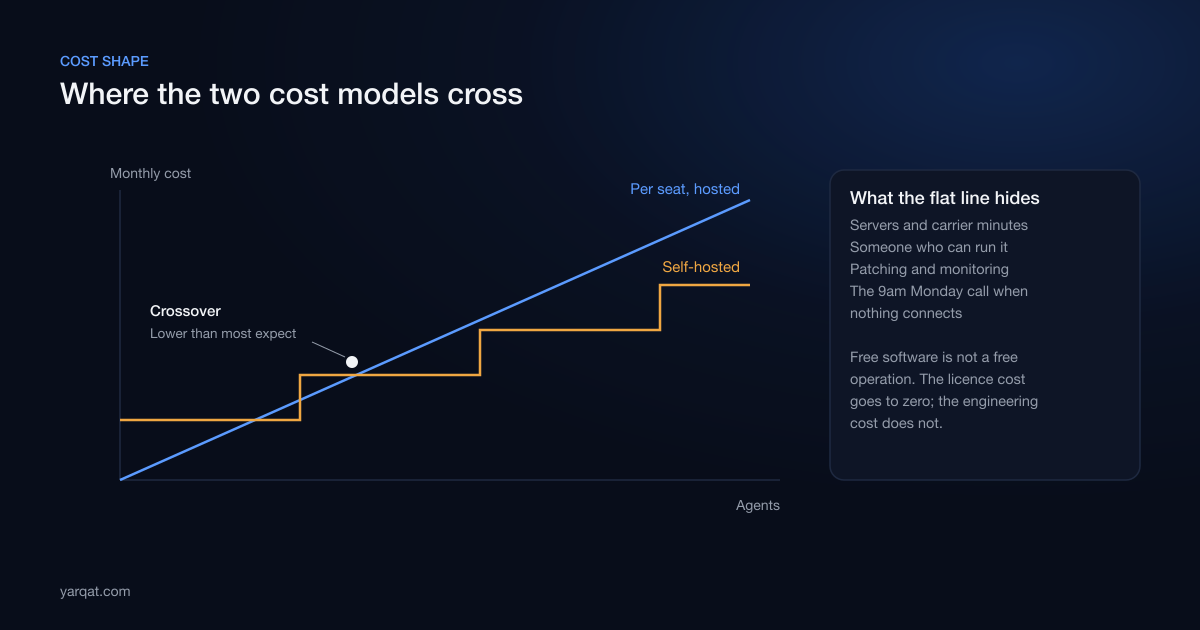
The two shapes
Hosted per-seat pricing is close to a straight line through the origin. Every agent you add costs the same as the last, forever. That is excellent when you have five agents and painful when you have two hundred, because nothing about the platform got cheaper as you grew.
Self-hosting is a staircase. There is a real cost to reach the first step, and then adding agents is close to free until you hit the next capacity boundary and buy another server. The line is not flat, but it is much flatter, and that difference compounds with headcount.
They cross. The only genuinely interesting question is where, and the answer is usually lower than people expect, because the per-seat figure is a recurring cost with no ceiling while most of the self-hosted cost is one-off or slow-moving.
What the self-hosted line actually includes
This is where the honest version of the comparison differs from the sales version. Removing the licence does not remove the cost, it changes who carries it.
- Servers. Modest for a small install, real for a cluster, and needing to be dedicated rather than cheap shared hosting because voice is timing-sensitive.
- Carrier minutes. You pay these either way, and they are frequently cheaper when bought directly rather than resold to you inside a per-seat bundle.
- Someone who can run it. This is the big one and the one that gets left out. Whether it is a person on your payroll or a retained partner, telephony competence has a price, and pretending otherwise is how installs end up unmaintained.
- Patching, monitoring and backups. Ongoing, unglamorous, and the difference between a system that runs for years and one that is quietly one failure from a bad week.
- The 9am Monday call. When nothing connects and a floor of agents is sitting idle, someone has to answer. With a hosted platform that is the vendor's problem. Self-hosted, it is yours, and the cost is measured in downtime as much as in fees.
Working through this on a real project?
Tell us what you are building or fixing. A senior engineer will give you a straight view of it, including when the honest answer is that you do not need us.
What the hosted line hides
The hosted side has its own omissions, and they tend to appear after the contract is signed.
- Per-minute charges on top of per-seat, sometimes at a healthy markup on the underlying carrier rate
- Charges for recording storage and retention, which grow as your archive grows
- Feature tiers, where the capability you actually need sits one plan above the price you were quoted
- Integration and API limits that turn into either a higher tier or an engineering workaround
- Minimum commitments and annual terms, which quietly remove the elasticity that was the main reason to go hosted
None of this makes hosted a bad choice. It makes the headline per-seat figure an unreliable basis for a decision.
Where each one genuinely wins
Hosted wins when
- Your seat count swings substantially with seasonal or campaign demand
- You have nobody to own infrastructure and no intention of hiring one
- You need to be live in days
- Your agent count is small enough that the crossover is far away
- You would rather have a vendor to escalate to at 9am on a Monday
Self-hosting wins when
- You run a stable, substantial agent count where per-seat pricing compounds
- You want your call data in a database you control, for reporting and CRM integration
- You need behaviour a vendor will not change for you
- Your margins are thin enough that per-seat cost is strategically significant
- You already have, or are willing to retain, the competence to run it
How to actually run the comparison
- Take your realistic agent count for the next 24 months, including the campaign you are hoping to win.
- Price the hosted option properly: per seat, plus per minute, plus recording storage, plus the tier that contains the features you actually need.
- Price the self-hosted option properly: servers, carrier minutes bought directly, and a genuine annual figure for the person or partner who will operate it.
- Compare total cost over 24 months, not per month. One-off build cost distorts a monthly comparison in a way that flatters hosted.
- Then ask the question the spreadsheet cannot answer: who carries the risk when it breaks, and are you comfortable with that answer?
The conclusion nobody sells
For a small or volatile operation, hosted is usually right and the open-source saving is illusory once you price the expertise. For a stable operation at scale, self-hosting is usually right and the per-seat saving is substantial enough to fund the engineering several times over.
The mistake is choosing on ideology in either direction. We build both, so we have nothing to defend: VICIdial where owning the stack pays, Twilio and similar where it does not. If you want the two priced against your actual numbers rather than a generic comparison table, book a free consultation or read how we approach call centre setup.