
VICIdial is known for outbound, and that reputation obscures a decent inbound platform sitting inside it: DID routing, IVR menus, queues with skills-based routing, callbacks and voicemail. For a business already running outbound, handling inbound on the same system avoids a second platform, a second set of reports and a second thing to keep running.
The catch is not inbound itself. It is blending, and blending is where most implementations go wrong.
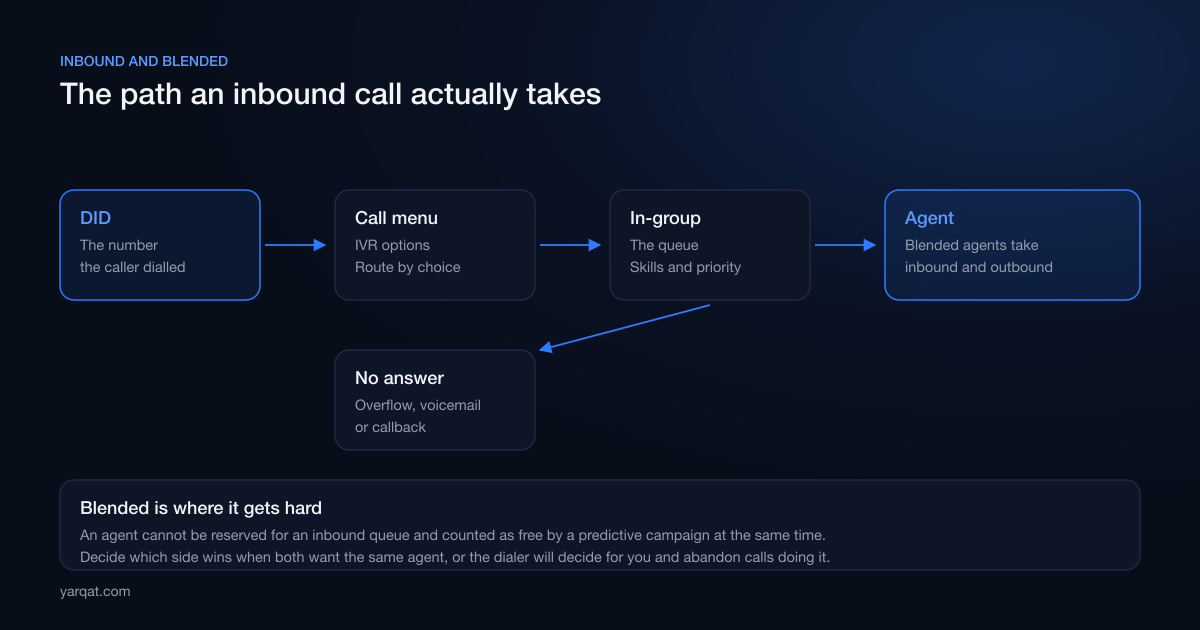
The path a call takes
A caller dials a number, and that number is a DID in your configuration. The DID decides what happens next, which is the first design decision people rush: one DID per campaign, per source or per client gives you routing and reporting for free, whereas pointing everything at one number throws away information you cannot recover later.
From there the call usually reaches a call menu, which is the IVR: press one for sales, two for support. Or it skips the menu entirely and goes straight to a queue, which is often the better experience when there is only one sensible destination.
Then it lands in an in-group, which is the queue. This is where waiting happens, where agents are matched by skill, and where you decide what a caller hears while they wait and how long they wait before something else happens.
Finally it reaches an agent, or it does not, in which case your overflow behaviour matters: voicemail, a callback, an alternative queue, or an honest message telling them when to try again.
Design decisions that matter more than they look
The IVR menu should be short
Every option you add costs every caller time, and the caller who wants option four hears three things they do not want first. Two or three options is usually right. If you genuinely need more, that is often a sign that one number is doing the job of several DIDs.
Decide what happens when nobody answers
This is the most-skipped configuration in inbound, and it is what customers actually experience on your worst day. A queue that rings forever is not a design, it is an omission. Set a maximum wait, and make the overflow deliberate: voicemail with a stated response time, a callback, or a message that says you are closed and when you open.
Match routing to how your team is actually organised
Skills-based routing is only as good as the skills mapping behind it, and that mapping goes stale as people change roles. If it is wrong, calls route to agents who then transfer them, which is worse than routing simply and honestly in the first place.
Set the caller ID and the recording position deliberately
Inbound recording obligations often differ from outbound, and notification requirements vary by jurisdiction. Decide the position once, apply it consistently, and record the decision, because "we assumed it was on" is a poor answer when a recording is needed.
Working through this on a real project?
Tell us what you are building or fixing. A senior engineer will give you a straight view of it, including when the honest answer is that you do not need us.
Blended: the hard part
Blending means one agent handles inbound and outbound. The appeal is obvious: agents stay busy during quiet inbound periods, and you do not staff two separate teams. The problem is a genuine conflict.
An agent cannot be reserved for an inbound queue and counted as available by a predictive campaign at the same time. Something has to give, and if you do not decide what, the dialer decides for you.
Concretely: a predictive campaign places calls based on how many agents it believes are about to be free. If some of those agents get grabbed by inbound calls first, the campaign has placed calls with nowhere to put them, and those become abandoned calls. Your abandon rate then rises for reasons that have nothing to do with your dial level, which makes it look mysterious. The mechanics of that number are covered in predictive dialing explained.
Making blended work
- Decide which side has priority, explicitly. Usually inbound wins, because a customer who called you is worth more than one you called. Whatever you choose, configure it rather than leaving it to chance.
- Keep a reserved inbound pool at peak. Rather than blending everyone, hold a group of agents on inbound only during known busy periods, and blend the rest. This protects answer times without giving up outbound entirely.
- Dial less aggressively on blended campaigns. A dial level that is safe on a dedicated outbound team is not safe when agents are being pulled away by inbound. Blending should reduce your dial level, and if it has not, you are probably abandoning calls without knowing why.
- Watch the abandon rate on blended campaigns specifically. Aggregated across all campaigns, a blended problem hides inside a healthy average.
- Give agents a clear signal about what they are receiving. The worst version of blended is an agent who does not know whether the person on the line called them or was called, because the first ten seconds of the conversation then go wrong.
The short version
Inbound on VICIdial is capable and worth using when you already run outbound. Get the DID structure right at the start, keep the menu short, and make the no-answer path a deliberate design rather than an oversight. Then treat blended as a scheduling and compliance decision rather than a checkbox, because that is what it is.
We configure inbound, outbound and blended operations as part of call centre setup, and we are often called in when the abandon rate on a blended campaign has become inexplicable. Book a free consultation if that sounds familiar.