
VICIdial is an open-source contact centre suite built on top of Asterisk. It gives you predictive, progressive and manual dialing, inbound queues, IVR, call recording, agent screens in a browser and a reporting layer, with no per-seat licence attached to any of it. That combination is why a great deal of the world's outbound calling runs on it, and why it keeps appearing on shortlists next to platforms costing a hundred pounds per agent per month.
It is also routinely misunderstood, in a way that costs people money. VICIdial is not an application you install and operate like a CRM. It is four separate systems that happen to ship together, and each of them fails differently.
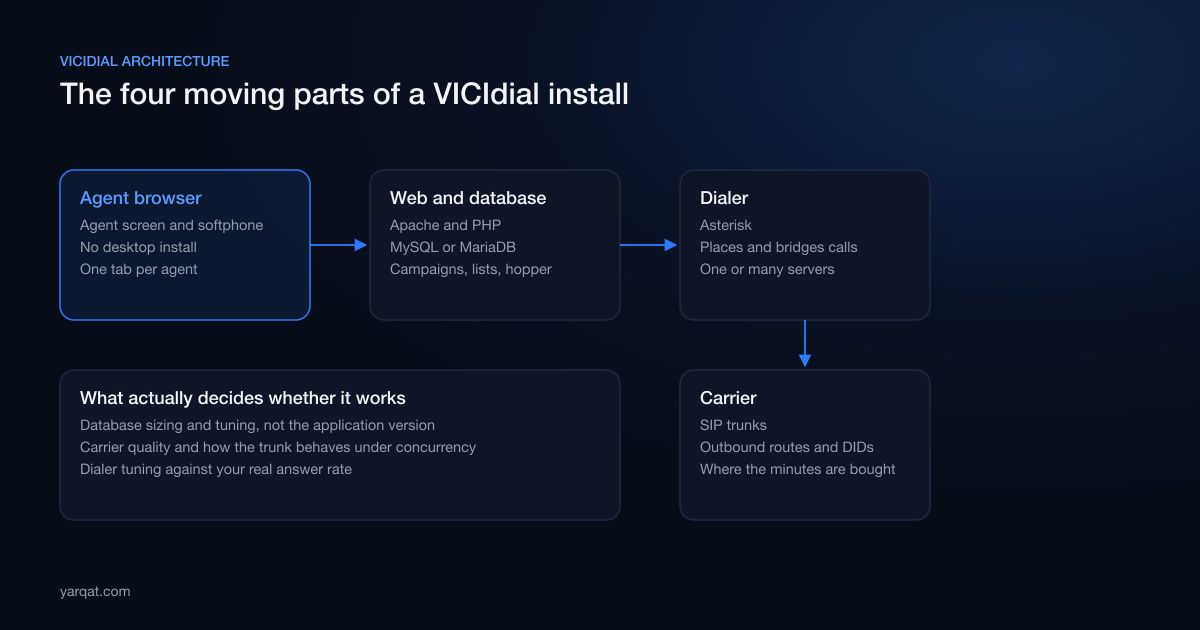
The four parts, and which one breaks
The agent interface runs in a browser. Agents log in, get calls, set dispositions and move on. Nothing is installed on their machine, which is one of the genuinely good design decisions in the platform.
The web and database layer holds campaigns, lists, leads, dispositions, recordings metadata and configuration. In practice this means MySQL or MariaDB, and this is the component that fails first at scale. Not Asterisk. The database.
The dialer is Asterisk. It places calls, detects what happened to them and bridges the answered ones to agents. When people say a dialer is fast or slow, they are usually describing tuning decisions rather than Asterisk itself.
The carrier is not part of VICIdial at all, and it is where a surprising share of problems live. Your SIP trunk provider determines call quality, how many concurrent channels you can actually use, what your caller ID does, and whether calls connect reliably at 9am on a Monday when every call centre in the country dials at once.
Almost every VICIdial problem we are asked to fix turns out to sit in the second or fourth of those, which is why "we tried VICIdial and it was unreliable" is usually a statement about a database that was never sized or a carrier that was chosen on price alone.
What you get without paying for it
The capability list is genuinely long, and it is worth being specific because people assume open source means a reduced version of a commercial product. It is not.
- Predictive, progressive, preview and manual dialing modes, with the dialing aggressiveness under your control
- Inbound queues with skills-based routing, and blended agents who take both inbound and outbound
- IVR menus, DID routing and callback handling
- Call recording, with the recordings on disk in a normal format rather than locked in a vendor's system
- Real-time monitoring, listening in, whisper coaching and barge
- A reporting layer, plus direct database access if you want to build your own
- APIs for pushing leads in and pulling results out, which is how it connects to a CRM
The last point matters more than it looks. Because the data sits in a database you control, integrating VICIdial with the rest of your business is an engineering task rather than a request to a vendor's roadmap.
Working through this on a real project?
Tell us what you are building or fixing. A senior engineer will give you a straight view of it, including when the honest answer is that you do not need us.
What it costs instead
Removing the licence does not remove the cost, it moves it. You now pay for infrastructure, carrier minutes and, unavoidably, someone who understands telephony. That last item is the one people underestimate, because it is not a line on a quote until something breaks.
The licence cost goes to zero. The engineering cost does not. Anyone who tells you otherwise has not been on the receiving end of a dialer that stopped connecting during a campaign.
The economics still favour self-hosting sooner than most people expect, particularly past a few dozen agents, because per-seat pricing scales linearly with headcount while infrastructure does not. We put the two side by side in VICIdial or a cloud dialer, including the costs that never appear in the comparison table.
When VICIdial is the right answer
It fits well when several of these are true:
- You run outbound at volume, where per-seat pricing becomes the largest line in the budget
- You have or can hire access to someone who can operate telephony infrastructure
- You want your call data in a database you control, for reporting or CRM integration
- You need to change how the system behaves rather than accept a vendor's product decisions
- Your agent count is stable enough that you are not paying for idle capacity
When it is not
Be equally honest about the other direction. A hosted platform is the better answer when your seat count swings wildly week to week, when you have nobody to own the infrastructure and no intention of hiring one, when you need something running within days rather than weeks, or when your call volume is genuinely small. Below roughly ten agents the maths rarely justifies running your own telephony, and we will say so rather than sell an install that will outlive its usefulness.
There is also a compliance dimension. Running your own dialer means the abandoned-call rate is your responsibility, set by your configuration. That control is an advantage when someone is watching it and a liability when nobody is. Predictive dialing explained covers exactly where that line sits.
The honest summary
VICIdial is a serious platform that will carry hundreds of agents, and it is free in the sense that nobody invoices you per seat. It demands competence in exchange. A default install will not survive real traffic, and the failures show up in the database, the carrier and the dialer tuning rather than in the software itself.
If you are weighing it against a hosted platform, the deciding question is not which is better. It is whether you want to own this layer of your operation or rent it. Both are defensible answers.
We build and operate VICIdial installs, and we are called in to rescue ones that have started dropping calls under load. Our VICIdial page covers the platform in more depth, call centre setup covers how we approach the build, and you can book a free consultation if you want a straight answer on whether it fits your operation.