
Predictive dialing is the reason people choose VICIdial, and tuning it is where most of the value and most of the risk sit. The concept is simple enough: place more calls than you have free agents, because most calls will not be answered by a human. The difficulty is that the same setting which keeps your agents busy is the one that drops calls on people who picked up, and that number is regulated.
The dialing modes, in plain terms
- Manual. The agent dials. No prediction, no abandoned calls, lowest throughput. Sometimes required by regulation for particular kinds of calling.
- Preview. The agent sees the record before the call is placed. Good where the conversation needs preparation, such as high-value or complex sales.
- Progressive. One call per free agent. The agent is connected as it rings. No abandoned calls by design, and modest throughput gains.
- Predictive. More calls than free agents, with the multiplier set by the dial level. This is where the throughput is, and where the compliance exposure is.
VICIdial also offers adaptive variants that adjust the dial level automatically against measured performance, which is generally a better default than a fixed number set by whoever configured the campaign last year.
What dial level actually means
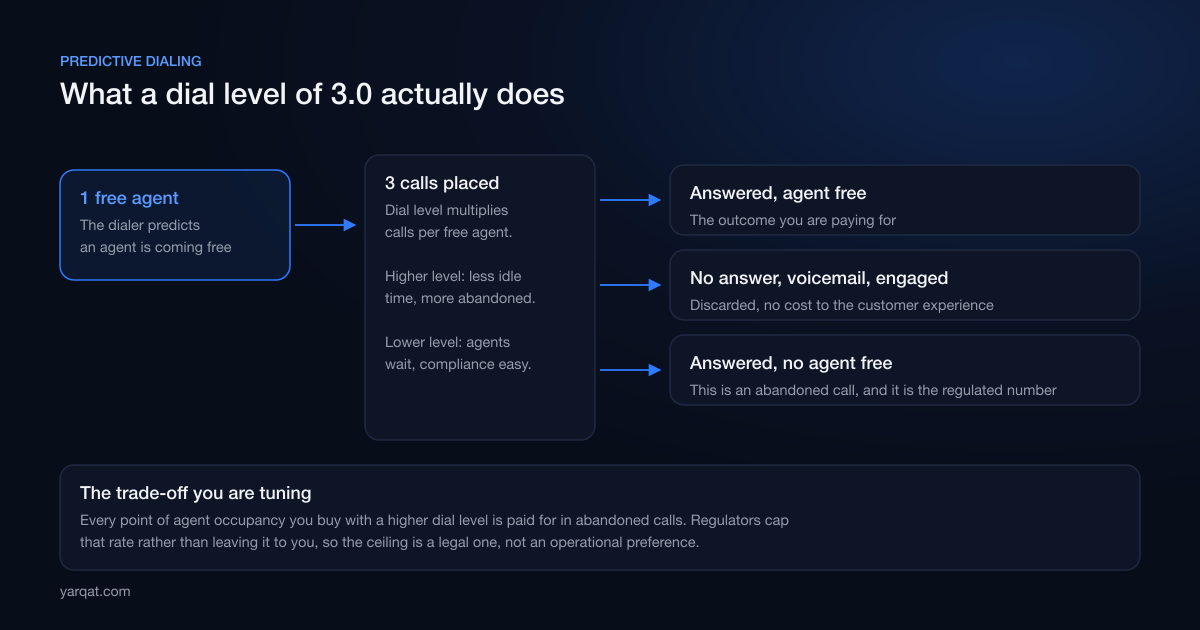
A dial level of 3.0 means three calls placed for every agent predicted to become free. Most of those calls will hit no answer, voicemail, an engaged tone or a dead number, so on average roughly one becomes a live conversation. The number is a bet on your answer rate for that list, at that time of day, on that caller ID.
When the bet is wrong in your favour, two or three people answer at once and there is only one free agent. The others get silence and then a disconnect. That is an abandoned call, and it is the number regulators care about.
The trade-off, stated honestly
Agent occupancy and abandoned calls move together. You cannot raise one without raising the other. Anyone selling you a setting that delivers both is describing a better answer rate, not a better dialer.
This is why "what dial level should we use?" has no universal answer. It depends on your answer rate, which depends on your data quality, your caller ID reputation, your calling window and your sector. A list of warm inbound enquiries behaves nothing like a cold list bought last month, and the same dial level on both will produce wildly different abandon rates.
Working through this on a real project?
Tell us what you are building or fixing. A senior engineer will give you a straight view of it, including when the honest answer is that you do not need us.
The compliance ceiling
Abandoned calls are regulated in most markets that matter, and the limits are not advisory. Several regulators have converged on a maximum abandoned call rate in the region of 3 per cent, measured per campaign over a defined period, along with requirements about playing an informative message when a call is abandoned and rules on how answering machine detection may be used. The specifics differ by jurisdiction and they do get revised, so treat the current published guidance of your regulator as the authority rather than anything you read in an article, including this one.
What matters operationally is this: the ceiling on your dial level is a legal number, not a preference. Measure the abandon rate continuously per campaign, alert on it, and treat a breach as an incident. A dialer tuned by someone watching only agent idle time will find that ceiling eventually, usually in the form of a complaint.
Answering machine detection, and why it disappoints
Answering machine detection listens to the start of a call and guesses whether it reached a person or a recording. It is genuinely useful and it is genuinely imperfect, and the errors cut both ways. A false positive hangs up on a real person, which is a poor customer experience and, in some jurisdictions, carries its own regulatory consequence. A false negative passes a voicemail to an agent, which wastes their time.
Tuning it is a matter of deciding which error you would rather make, and being honest that you cannot eliminate both. Aggressive detection protects agent time at the cost of hanging up on customers. Conservative detection does the opposite. There is no setting that avoids the choice.
How to tune it without breaking anything
- Measure your real answer rate per list and per time of day. Not an average across everything. The variation between a fresh list at 6pm and a stale one at 10am is enormous, and a single dial level across both is guaranteed to be wrong for one of them.
- Start conservative and move in small steps. Raise the dial level gradually and watch the abandon rate after each change. Jumping straight to an aggressive number and correcting downwards means the correction happens after the damage.
- Use the adaptive modes. Letting the dialer adjust against measured performance handles the variation between lists and hours far better than a fixed number anyone maintains by hand.
- Alert on the abandon rate, not just the report. A weekly report tells you about a breach after a week of breaching. An alert tells you the same day.
- Fix the data before raising the dial level. Better data raises the answer rate, which raises agent occupancy without touching the abandon rate. It is the only lever that improves both sides at once, and it is the one teams skip because it is unglamorous.
The point most teams miss
Dial level tuning has a hard ceiling set by law, and most operations reach it long before they have exhausted the improvements available in list quality, calling windows and caller ID reputation. If your agents are idle and your abandon rate is already at the limit, the dialer is not your problem. Your data is.
We tune predictive dialing as part of building and operating contact centres, including installs that are already over the line and need to come back under it. See call centre setup, read what VICIdial actually is for the platform overview, or book a free consultation.